Mining the Design Space
of Multi-Agent Workflows

From workflow search traces to reproducible
principles for multi-agent design.

Xavier Cadetα,* Junyan Chengα,* Peter Chinα Kyle Richardsonβ

α Dartmouth Collegeβ Allen Institute for AI

* Equal contribution

XC: system implementation & operator set, large-scale experiments, data analysis, and empirical write-up;

JC: project conception, theoretical framework & instruments, experimental design, and theoretical write-up.

Browse the workflow database
28,568executable workflows
26verified reasoning tasks
6composable operators
300feature-mining trials

What makes a multi-agent
workflow work?

Building multi-agent systems still relies on trial and error. Manual studies explore a handful of communication patterns; automated optimizers keep a task-specific winner and discard the rest.

Our system, APEX (Automatic Principle Exploration System), turns those intermediate designs into evidence. By retaining complete search trajectories, then mining workflow code and prompt templates, we identify design principles that persist on held-out searches.

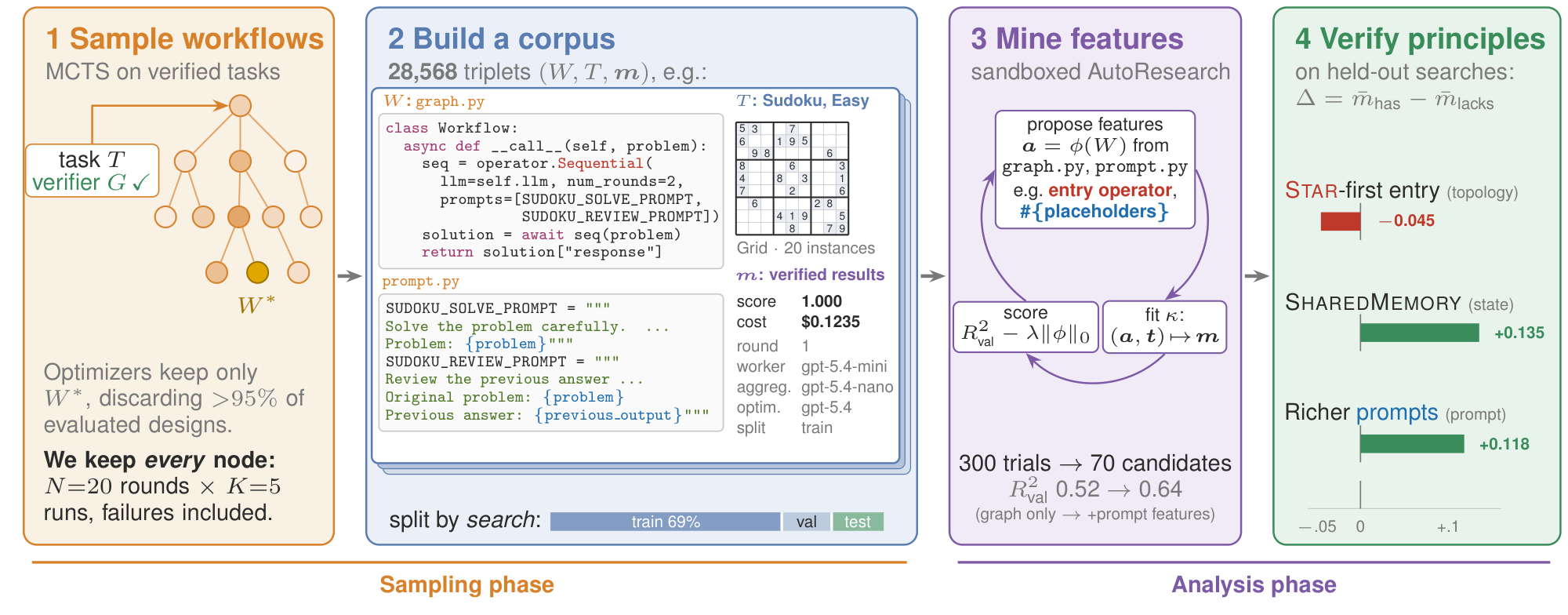
Four-stage pipeline: AFlow samples workflows, evaluated workflows form a corpus, AutoResearch mines code and prompt features, and held-out searches verify candidate principles.
FIG. 01Keep the whole search. Sample workflows, build a corpus, mine features, and verify principles on held-out searches.
Read the full abstract

Designing large language model (LLM) multi-agent systems (MAS) still relies on trial and error and informal “folk wisdom.” Manual studies test only a few communication structures or topologies (e.g., sequential, parallel, shared-memory, or debate), while automated optimizers discard search trajectories after selecting a task-specific workflow. We present a two-phase pipeline for mining reproducible design principles from workflow code and execution traces. We repurpose AFlow’s MCTS optimizer across six composable operators and 26 deterministically verified Enigmata tasks, retaining all intermediate rounds to build a corpus of 28,568 executable workflows. A sandboxed AutoResearch loop then mines orchestration code and prompt templates under an L₀-penalized validation objective and tests candidate principles on held-out searches. Across 300 feature-mining trials, we identify effects that persist on held-out searches across three levels of workflow design: workflows beginning with independent solvers and one-shot aggregation (Star-first) perform worse (Δ = −0.045); persistent shared documents (SharedMemory) outperform debate (Δ = +0.135); and prompt specificity and placeholder-based context routing yield gains comparable to communication-structure selection (Δ = +0.118). More broadly, our pipeline and results show the feasibility of turning discarded search trajectories into a statistical testbed for discovering and validating multi-agent workflow design principles.
Three levels of design.
Three reproducible signals.

Workflow entry points, communication state, and the structure inside the prompts all carry predictive information.

01 ENTRY-POINT TOPOLOGY
−0.045median Δ on held-out searches

Rethink isolated fan-out.

Workflows that begin with independent solvers and one-shot aggregation (Star-first) score lower than alternative entry topologies.

Explore Principle 1
02 COMMUNICATION STATE
+0.135median Δ on held-out searches

Give agents shared state.

Workflows using a persistent written document (SharedMemory) outperform workflows without it in the held-out comparison.

Explore Principle 2
03 PROMPT STRUCTURE
+0.118median Δ on held-out searches

Look inside the prompts.

Richer prompt templates predict gains comparable to topology selection. Named placeholders also carry a positive signal for context routing.

Explore Principle 3

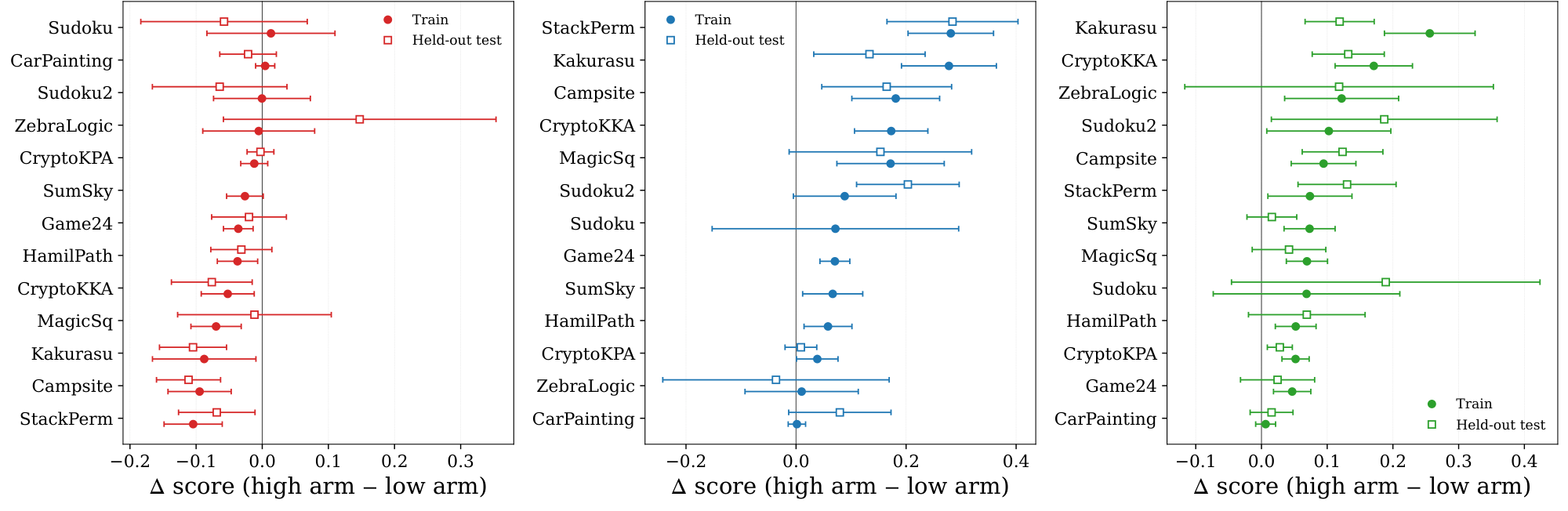
Δ is the median per-puzzle score contrast between high and low feature arms. These are observational associations under the study’s sampling policy; task-specific magnitudes have finite-sample uncertainty.

Star-firstShared memoryRicher prompts
Per-puzzle effect sizes for Star-first, SharedMemory, and richer prompts, comparing training and held-out test splits with 95 percent cluster-robust confidence intervals.
FIG. 02Beyond an average. Per-puzzle contrasts and uncertainty, with train and held-out test results shown together.

Search for workflows.
Then search for principles.

Two phases connect executable designs to statistically testable patterns.

PHASE 01 / SAMPLING

Keep every evaluated design.

AFlow composes six operators over 20 MCTS rounds, across five independent runs per condition. Deterministic Enigmata verifiers evaluate fixed bundles of reasoning problems.

Code + prompts + verified outcomes
PHASE 02 / ANALYSIS

Mine, then verify.

A sandboxed AutoResearch loop proposes interpretable features under an L₀-penalized validation objective. Entire searches are kept together across training, validation, and test splits.

Search-level splits · Held-out verification
INTERACTIVE EXAMPLE

Follow the conversation.

Illustrative · no LLM calls

Choose a communication pattern, change the scale, and step through who sees what. All calls also receive the original problem.

Star workflowParallel workers feed one aggregator.
Worker callHub callActive stage

Star uses one round of independent answers.

4LLM calls
2sequential stages

Ready. Step through the workflow.

Star

Workers solve independently. A single aggregator sees their outputs and synthesizes the final answer. Workers do not see each other’s proposals.

PROMPT ROUTING EXAMPLE

Same task. Different context.

Illustrative prompt templates

In the paper’s Star → Sequential example, the final validator receives both the original Sudoku puzzle and the draft answer. Toggle the placeholders to see what reaches it.

WHAT THE VALIDATOR SEES

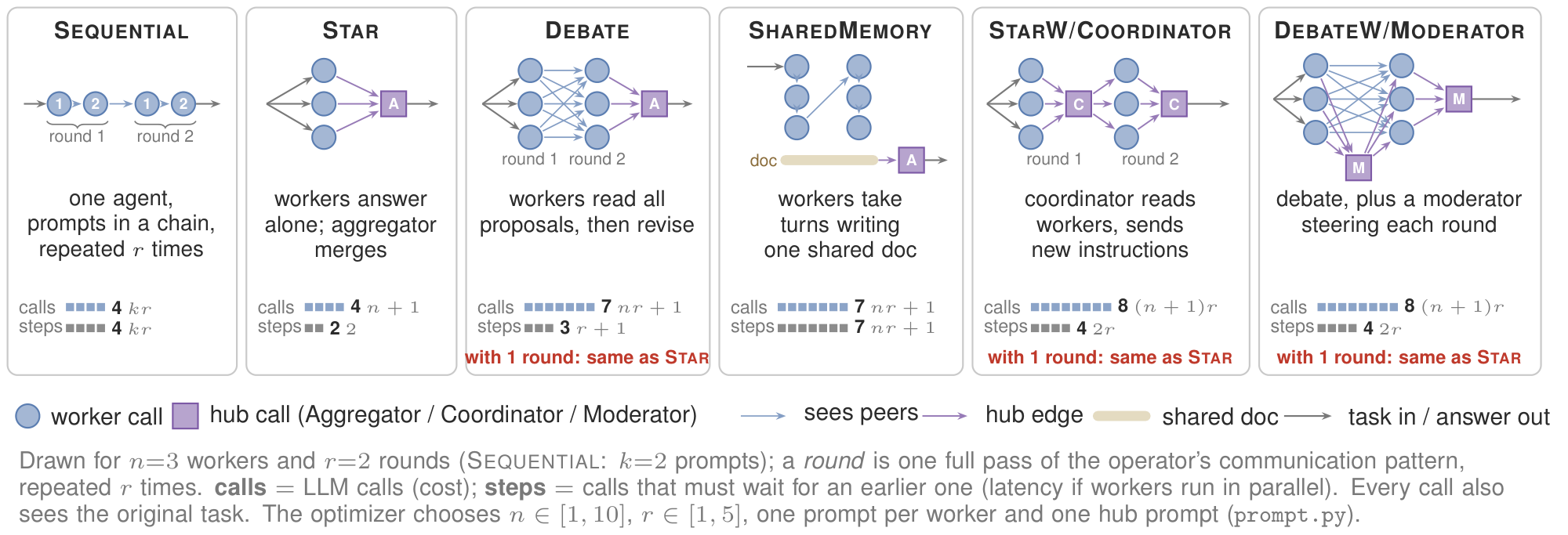
Six operator topologies: Sequential, Star, SharedMemory, Debate, StarWithCoordinator, and DebateWithModerator.
FIG. 03A composable design space. Six familiar communication patterns become building blocks for multi-stage workflows.
THE VALUE OF PROMPT FEATURES

Structure tells part of the story.

Adding prompt-template features improves validation R² from 0.521 to 0.638.

Workflow code
0.521
Code + prompts
0.638
VALIDATION R² · HIGHER IS BETTER

Explore the work.

The paper, implementation, and LaTeX source in one place.

Cite this work.

arXiv:2610.31709 [cs.SE]

@misc{cadet2026miningdesignspacemultiagent,
  title         = {Mining the Design Space of Multi-Agent Workflows},
  author        = {Xavier Cadet and Junyan Cheng and Peter Chin
                   and Kyle Richardson},
  year          = {2026},
  eprint        = {2610.31709},
  archivePrefix = {arXiv},
  primaryClass  = {cs.SE},
  url           = {https://arxiv.org/abs/2610.31709}
}